
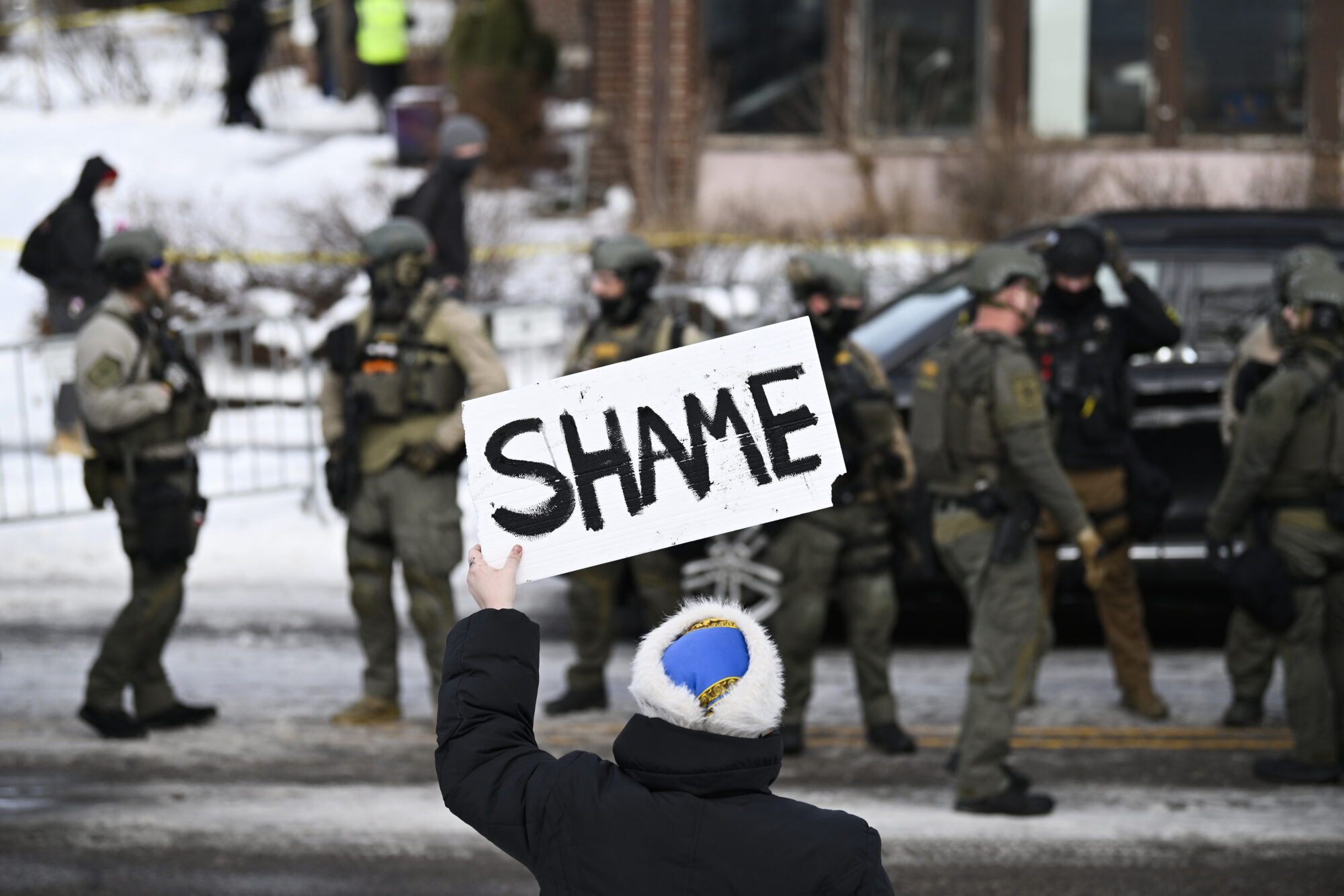
Since January 7, protests have broken out across Minnesota in response to the current administration’s abusive immigration policies and secret police tactics, which resulted in the murder of Renee Good, an American citizen and Minneapolis resident, by an Immigration and Customs Enforcement agent. Instead of showing presidential empathy and leadership, President Trump has stoked the fire by threatening to invoke the Insurrection Act for the first time in more than three decades.
He’s made this threat before but seems more focused on it than ever. Here’s what you need to know.
- The Insurrection Act — provisions of federal law that date back to 1792 — allows the president to use the military as a domestic police force in certain emergencies such as an “insurrection, “rebellion,” or “invasion.” Historically, the Insurrection Act is used rarely and in extreme emergencies when civilian police cannot or will not enforce the law. The Department of Justice’s Office of Legal Counsel has described invoking the Insurrection Act against the objection of the state’s governor as available only when “state and local law enforcement have completely broken down (PDF).” Most legal experts believe the Insurrection Act’s authorities are limited to these circumstances. The last time it was invoked was in 1992 when the governor of California and mayor of Los Angeles requested support from the National Guard to restore order after people rioted in response to police officers beating Rodney King. The riots caused over 60 deaths, 2,000 injuries, 4,000 fires, and $1 billion in property damage. And the last time the Insurrection Act was invoked over the objection of a state’s governor was in 1965, when President Lyndon B. Johnson sent the U.S. armed forces to Alabama to protect protestors marching in support of Black voting rights. In what is now known as Bloody Sunday, they had previously been attacked by Alabama state troopers at the Edmund Pettus Bridge during their pilgrimage from Selma to Montgomery.
- It would be unlawful for the president to invoke the Insurrection Act to quash pro-immigrant protests. There is no insurrection, rebellion, invasion, or other emergency in Minneapolis that would justify invoking the Insurrection Act. Instead, protests have been overwhelmingly peaceful and state and local law enforcement in Minnesota have been capably handling the limited acts of violence among the protesters. The violence and disorder captured in social media posts have come almost entirely from federal agents, who currently outnumber the 10 largest regional police forces combined. Unlike in the case of the Rodney King riots, the governor of Minnesota and the mayor of Minneapolis have not sought outside support for the protests taking place today, which are mild in comparison.
- Deploying the military to conduct domestic policing outside of the Insurrection Act (or another authority) is a crime. The military is trained for fighting wars against enemy combatants, not policing civilians. However, authoritarians throughout history have often used the military to dismantle democratic systems and seize power. That’s why Congress, under the Posse Comitatus Act, made it a crime to use the military for civilian law enforcement purposes without constitutional or congressional authorization. The ability to invoke the Insurrection Act is one of the exceptions. So, if the president were to intentionally try to invoke the Insurrection Act without justification so that he could use the military to control and police civilians, he would be committing a crime.
- Invoking the Insurrection Act to deploy the military on U.S. soil is not the same as declaring “martial law.” Even if the president were to succeed in convincing courts of his flimsy argument that the Insurrection Act would apply to the situation in Minneapolis, he would not be declaring “martial law.” While “martial law” does not have a clear legal definition, it’s much closer to what you probably assume it is: the military entirely taking over the functions of local, civilian government. With martial law, we’re not just talking military police: we’re also talking military courts, military government administrators, and the military issuing orders to civilians rather than taking orders from civilian government officials under the law. Martial law also often comes with legally ambiguous civil rights violations, such as suspending habeas corpus, a constitutional right that guarantees any detained individual a hearing before a judge, and due process; censoring media, public figures, and individuals; and setting curfews. The Insurrection Act, by contrast, only allows the military to assist civilian law enforcement by enforcing existing law and engaging in traditional police activities like making lawful arrests, responding to acts of violence, or maintaining order during riots. The Insurrection Act cannot and does not override constitutional protections, such as your First Amendment right to freedom of speech and assembly, or your Fourth Amendment right against unreasonable searches or seizures.
- President Trump has used other dubious authorities to deploy the military in American cities, but a more worrisome and potentially broader invocation of the Insurrection Act may be coming. The president has claimed inherent constitutional authority to use the military domestically to protect federal buildings and agents, which continues to be litigated. He also tried to unlawfully use state National Guard forces in California, Oregon, and Illinois for the federal government under a different federal law, which the Supreme Court rejected. Because courts have restricted the president’s attempts to deploy the military in American cities using other presidential loopholes, President Trump may decide to finally invoke the Insurrection Act to advance his personal goal of using the military for political ends.
If President Trump does decide to invoke the Insurrection Act, he will be met with resistance in various forms, including litigation. If you witness any conduct by military personnel that you believe is unlawful, let us know by e-mailing us at [email protected].
In the meantime, your voice is important. Reach out to your senator and members of Congress and let them know you’re against this abuse of presidential power and the reckless and violent crackdown on immigrant communities in Minneapolis. Stand up for the friends, families, and neighbors who are exercising their First Amendment rights to speak out against injustice. Congress must not continue to fund an authoritarian and secret national police force that has no accountability.
Tell Congress: No More Tax Dollars for ICE & CBP. We Demand Accountability.
Urgent: Members of Congress are considering more funding for ICE & CBP as they consider spending bills for federal agencies before the January 30th deadline. Congress cannot give ICE and CBP another dollar while they continue to visit terror on our communities. We demand real limits, strict accountability, and an end to this violence.
Send a MessageHow to Find a Loved One After a U.S. Immigration Arrest
Updated Oct 20, 2026 This guide will help you look for someone who was taken by immigration officers and may be facing deportation.
The Door v. Edlow
This lawsuit challenges the government’s broad attempts to rush the deportation of unaccompanied children in violation of their civil rights and U.S. law.
Last update: Oct 19, 2026
Advocates for Unaccompanied Children File Lawsuit to Stop Federal Government’s Fast-Track Deportation Scheme
Published Oct 15, 2026 Legal service providers representing immigrant children filed a challenge in federal court today to stop the cruel and unlawful scheme to fast-track children’s asylum cases.
Benefits for Immigrant Survivors of Trafficking, Domestic Violence, and Other Serious Crimes in California
Updated Oct 6, 2026 This resource reviews the two categories of immigrants covered by California's SB 1569 (trafficking survivors and U visa applicants/holders), the benefits they may receive, and what they need to show in order to get these benefits. Originally...
Five Things You Should Know About the Insurrection Act
Jan 21, 2026 President Trump is threatening to invoke the Insurrection Act in response to lawful protests against ICE in Minneapolis. He's made this threat before but seems more focused on it than ever. Here's what you need to know.