- Introduction
- Ending Collaboration between Criminal and Immigration Enforcement
- Banning Immigration Officers from Hiding their Identities
- Protecting Data Privacy
- Protecting Sensitive Locations
- Protecting Students
- Protecting Access to Health Care
- Supporting Equal Access to Education
- State Profiles
- Conclusion
In communities across the country, people are fighting back against the second Trump administration’s mass deportation agenda. The administration’s first year was cruel and deadly. More people were held in immigration detention than ever before. Federal law enforcement was deployed in unprecedented numbers, with “at-large” arrests up 600%. Communities across the country — including Chicago, Minneapolis, and Los Angeles— were torn apart violently for the world to see. And the 2025 Reconciliation Act turbocharged the budgets for Immigration and Customs Enforcement (ICE) and Customs and Border Protection (CBP), dumping $170 billion into the government’s anti-immigrant slush fund.
But as the policies grow more extreme and the tactics more violent, communities have only become more united and resilient. State officials and local organizers are bringing the fight to their state capitals. In states across the country, legislatures are exercising their power to protect their communities by standing up to this oppressive enforcement regime. Each bill is the hard-fought result of robust efforts by community-based organizations and collaborations across the country.
This report captures a compilation of pro-immigrant state laws enacted in 2025 and bills signed in the first five months of 2026 to address immigration enforcement. In many other states, similar bills are on their way to the governor’s desk. The momentum in this work is striking. Lawmakers in the 2026 session have increased not only the number of anti-enforcement bills, but also their ambition in exercising local power. Advocates from coast to coast have won long-sought victories, like the 10-year fight in Maryland to root out local police collaboration with ICE, one of five major bills passed in 2026. Oregon enacted eight laws this year protecting immigrant communities.
The bills featured in this report represent a mere snapshot of the positive momentum that advocates, organizers, and neighbors are leading. As threats continue to mount, organizers can build on these victories by advocating for more government accountability and stronger protections for community members across the country.
States Pushing Back on Trump's Enforcement Regime
July 2026
- Limited collaboration between law enforcement and federal immigration enforcement
- Banned immigration officers from hiding identities
- Enacted data privacy laws
- Passed multiple laws, spanning limiting collaboration, stopping identity concealment, and protecting data
- Limited collaboration between law enforcement and federal immigration enforcement
- Banned immigration officers from hiding identities
- Enacted data privacy laws
- Passed multiple laws, spanning limiting collaboration, stopping identity concealment, and protecting data
The lines between immigration enforcement and policing have long been blurry, but the start of the second Trump administration marks a spike in the number of local law enforcement agents working double duty as immigration agents since the beginning of the Trump administration. By participating in a program commonly referred to as 287(g) (PDF), local police departments and sheriff’s offices are deputized as ICE agents, casting the web of immigration enforcement even wider. 287(g) programs undermine public safety and destroy community trust in public institutions. Under these agreements, a simple traffic stop could result in a family ripped apart.
According to DHS’s own data, 1,255 new 287(g) agreements were signed within the first year of the Trump administration. Now, nearly one-third of the country lives in an area with a 287(g) agreement. But states across the country are stepping up to end this violent collaboration.
The New Mexico Immigrant Safety Act (HB 9) takes several major steps to prevent state resources from supporting immigration enforcement, including banning any participation in the 287(g) program. The law also prohibits local governments from entering into agreements with ICE to hold people in their jails for immigration violations and using public property for immigration detention.
Maryland’s Community Trust Act (SB 791) prohibits local jails from working with ICE to detain people on immigration-related grounds. Maryland also took a large step in the fight against private immigration detention and ordered a ban on any approvals for new private immigration detention facilities (HB 1017).
Delaware passed a law that bans any new agreements or extensions of existing collaboration agreements (HB 182). Maryland passed an anti-287(g) law (SB 245 /HB 444) that also prevents any extensions or new agreements and requires any current agreements to end. While stopping short of an outright ban, Vermont’s law adds a step before local law enforcement agencies may enter into 287(g) agreements by requiring the governor to authorize any such requests. Maine passed a law (LD 1971) that, among other things, bans law enforcement from detaining people for immigration holds, the use of DHS officers as interpreters, and the sharing of personal data for immigration enforcement purposes. The law also bans Maine law enforcement from performing immigration enforcement-related activities. Virginia’s HB 1441/SB 783 prohibits state law enforcement from supporting or providing any resources to immigration enforcement operations. The law also states that any immigration enforcement agreements must meet certain requirements, including limits on enforcement in pre-defined sensitive areas.
New York’s comprehensive “Local Cops, Local Crimes Act” (S 9005C/A 10005C) includes several pro-immigrant provisions, including several on the entanglement between state and federal law enforcement. The law voids all existing 287(g) agreements and bans any future 287(g)s. It further drives a wedge between state government and ICE/CBP by restricting the use of government resources and state employees for immigration enforcement.
Hawaii (HCR 175) passed a measure that urges county planners and agencies to deny any permit applications that are related to constructing, expanding, or using warehouse facilities for immigration detention.
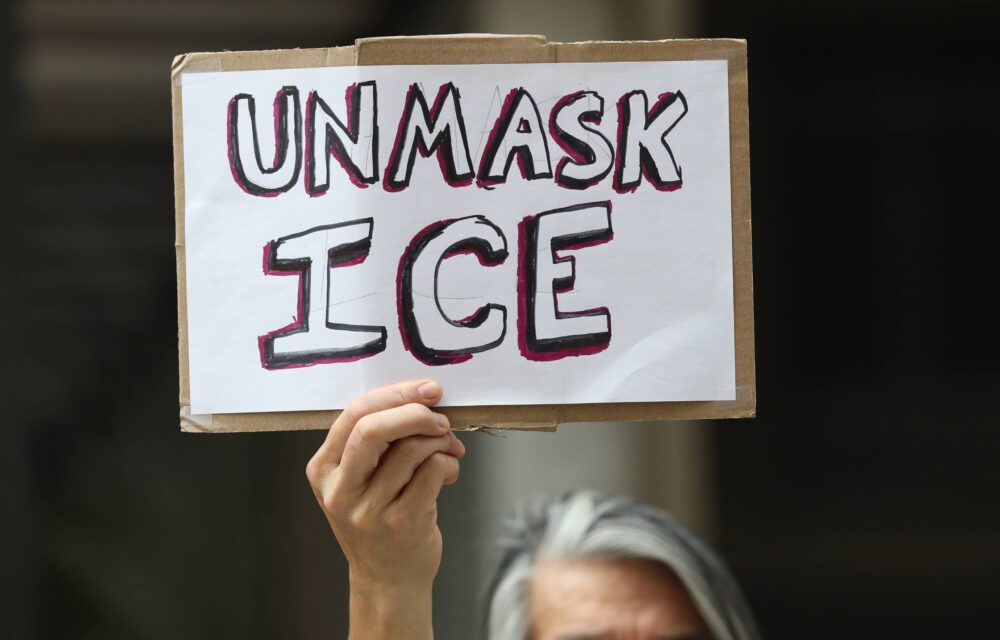
Federal agents increasingly have used masks during immigration raids and roving patrols, creating a grave threat to public safety. By hiding their identities, individual officers can get away with illegal and violent behavior without facing accountability. Recognizing the fear that disguised agents cause in their communities, several states passed laws that ban law enforcement agents – and ICE agents – from wearing masks while on duty.
California’s law (SB 627) bans local and federal law enforcement agents (as well as agents from other states) from wearing masks. Taking it a step further, the state adopted a second law (SB 805) that requires law enforcement agents to identify their agency as well as their badge number or name. This law also tackles the issue of people impersonating federal officers, including ICE agents. However, the federal government sued to prevent these two laws from going into effect. A district court temporarily blocked SB 627’s mask ban. On April 22, 2026, the federal government won a temporary injunction (PDF), blocking SB 805’s requirement that federal officers show identification. The case is ongoing.
Connecticut (SB 397), Maryland (SB 1), New Jersey (S 3114), Oregon (HB 4138), and Washington (SB 5855) also passed laws that ban masks and require law enforcement officers to identify themselves.
The Trump administration has been busy developing a massive surveillance state, and immigration enforcement plays a big role in that endeavor. Recognizing the fragility of the digital frontier, many states have passed laws designed to protect consumer privacy, including limits on the use of state databases containing personal information for immigration enforcement.
California enacted two data privacy-related laws in 2025. First, it amended the California Consumer Privacy Act (via SB 361) to require data brokers to publicly report whether they collect citizenship and/or immigration status information. The state also enacted SB 580, which orders the state attorney general to establish guardrails for personal information collected in state and local databases — including databases maintained by private operators. The attorney general’s guidance will limit the use of that information for immigration enforcement. Oregon’s SB 1587 also prohibits state agencies from sharing information with private data brokers unless they can guarantee it will not be shared with immigration enforcement.
New Mexico also passed a law (SB 36) that prevents state agencies from sharing personal information for immigration enforcement purposes. State agencies like the Department of Health, the Crime Victim Reparation Commission, and the Department of Transportation are now barred from sharing information, such as a person’s name or address, with law enforcement for immigration activities.
Colorado’s data privacy law (HB 25-1234) improves access to its Low-income Energy Assistance Program (LEAP), a critical social safety net. Program administrators cannot ask questions about citizenship or immigration status when a person applies for LEAP, except where required by law or court order. Any information shared about immigration status with federal enforcement agencies is also banned, with the same exceptions. This should help people feel more comfortable applying for assistance with heating their homes.
New Jersey’s new Privacy Protection Act (A 6309/S 5037) takes sweeping action to protect immigration-related data. With exceptions for what’s needed to administer public benefits or programs, the law limits the collection, use, and disclosure of information about immigration status, place of birth, Social Security Number (SSN), or Individual Taxpayer Identification Number (ITIN). Any information that is collected will not be considered a public record, with very narrow exceptions.
Drivers are also targeted by surveillance. Virginia (HB 1441/SB 783), New Mexico (SB 40) and Washington (SB 6002) have enacted new protections for data collected by automatic license plate readers (ALPRs). Washington’s law also imposes a fee for violating those protections and makes it unlawful for any agency to use an ALPR system for immigration investigation or enforcement.
These kinds of laws are critical for safeguarding vast amounts of personal data and for building trust between local government and communities. The digital world can feel like the Wild West, but when people feel that their personal information is protected, they are able to breathe a little easier. As technology continues to evolve, so will these laws.
States Passing Policies to Strengthen Communities
July 2026
- Protected sensitive locations, like schools, health care facilities, courthouses, and places of worship, from immigration enforcement
- Protected access to schools for all students and/or supported equal access to education
- Protected access to health care
- Passed multiple laws, spanning protecting sensitive locations and access to school, education, and health care
- Protected sensitive locations, like schools, health care facilities, courthouses, and places of worship, from immigration enforcement
- Protected access to schools for all students and/or supported equal access to education
- Protected access to health care
- Passed multiple laws, spanning protecting sensitive locations and access to school, education, and health care
Decades of data show that the fear and disruption caused by immigration enforcement undermines the health and safety of communities. Yet one of the Trump administration’s first steps in expanding its scope of enforcement was to rescind the guidance that protected sensitive locations such as schools, health care facilities, courthouses, and places of worship from immigration enforcement.
Under this long-standing guidance, the Department of Homeland Security directed officers to avoid enforcement activity in these “protected areas” except in very rare circumstances. The end of this policy means that children and families may be targeted at or near schools, at the doctor’s office, and at the places where they worship. These spaces form the pillars of a community – and now they are squarely in ICE’s crosshairs.
But new state laws require facilities under their control to adopt policies that prevent immigration enforcement officers from entering non-public areas without a signed judicial warrant. Maryland emerged as a leader when it passed the Maryland Values Act of 2025 (HB 1222), the first state-level law passed in response to the sensitive locations rescission. The law requires federal law enforcement to notify local officials when they’re carrying out immigration enforcement activities at schools, libraries, state-operated health care facilities, and courthouses. The MD attorney general is also required to develop guidance for responding to enforcement in sensitive locations, and those working at sensitive locations are required to deny federal immigration officers entry to certain non-public areas. In 2026, the state expanded the scope of the law in schools and added courthouses to the list of covered locations (SB 810). New Jersey’s Safe Communities Act (A6308 / S5036) is similar in its response. It orders the state attorney general to develop a range of model policies that facilities are required to adhere to for protecting access to critical sites, including health care facilities, public schools, domestic violence shelters, emergency shelters, family and youth shelters, food pantries, funeral homes, harm reduction sites, offices of social services, correctional facilities, and courthouses. New York (S 9005C/A 10005C), Maine (LD 2106), Illinois (HB 1312) and Colorado (SB 25-276) also passed protections against immigration enforcement at sensitive locations including schools, daycare centers, and health care facilities in their respective states. Connecticut (SB 397) also established protections for a wide range of sensitive areas, ensuring that its communities can get care, celebrate, mourn, learn, and live their lives without fear.
Several states have passed laws that protect access to schools, helping to ensure that all students have opportunities to thrive. Under SB 98, California schools must develop a school safety plan, which includes procedures for informing students, faculty, and staff when ICE is present at elementary and secondary schools. The law requires higher education institutions to notify students, faculty, and staff when the presence of immigration enforcement on campus is confirmed. California also enacted AB 49, which prohibits schools from allowing officers conducting immigration enforcement to enter schools without a judicial warrant or court order. Connecticut’s SB 7066 mandates that each school district develop updated security protocols for interacting with federal immigration agents.
Similarly, Delaware passed HCR 20, which formally urges state districts to develop clear policies on how to interact with immigration officials on school grounds. Oregon passed a law (HB 4079) that requires all K-12 and higher education institutions to establish procedures for providing notice of the presence of immigration enforcement agents at schools.
Immigration enforcement is particularly destabilizing for infants and school-aged children. California’s Family Preparedness Plan Act (AB 495) helps with finding caretakers for children if a parent is detained or deported. It also prohibits licensed child daycare centers and state preschool programs from collecting information on immigration status of children or their families, with certain limited exceptions. Illinois’s sweeping HB 1312 includes protections for daycare centers that face immigration enforcement actions without a judicial warrant and proper ID.
Numerous studies demonstrate that eligible immigrants and U.S. citizens have been afraid to seek health care because of their or a family member’s immigration status. That chilling effect not only threatens the health of the individual but also compromises the health of the broader community and the hospital system that serves all of us. In addition to the danger of enforcement actions at or around health care facilities, hospitals are also reporting problems that arise when officers arrive at their facilities with a detained person who needs medical care. Immigration agents’ presence can impede the care of these patients and undermine confidentiality and safety for other patients as well.
Recognizing these threats, states have enacted laws to protect patient privacy and safeguard their constitutional rights. Rhode Island passed a law (HB 6244) that bars health care facilities from asking patients for information or documents about immigration status. In a similar attempt to protect the trust between providers and patients, California’s SB 81 prevents doctors and providers from sharing medical and status-related information for immigration enforcement. To help ensure that the space feels safer for patients, it also prohibits access to places within a health care facility that are not open to the public without a judicial warrant and requires providers to give instructions to all staff and volunteers about how to respond to requests for access to such private spaces. Maryland’s SB 792 establishes model policies for hospitals to take when responding to the presence of immigration officers.
Oregon’s recently signed Health Care Without Fear Act (SB 1570) continues this trend. The law requires health care facilities (including hospitals and federally qualified health centers) to adopt policies on how to respond to law enforcement at hospitals. The law also clarifies that information related to immigration or citizenship status is to be treated the same as protected health information under state law. Not only does this law clarify protections for patients, but it also establishes protections for employees. Under this new law, it is considered an unlawful employment practice for health care facilities to take disciplinary action against an employee for sharing “know your rights” or legal aid resources with patients.
In a direct rebuke of federal threats to undermine equal access to education, which was enshrined in the 1982 Plyler v. Doe ruling, Illinois’s HB 3247 prohibits schools from denying free K-12 education based on a student’s or parent’s/guardian’s immigration status. Excluding students from programs or activities on that same basis is also unlawful. Virginia’s new education protections (HB 836/SB 491), modeled on the Illinois law, similarly prohibit denying enrollment in public K-12 schools based on actual or perceived immigration or citizenship status of a child, parent, or guardian. New York’s S 9005C/A 10005C includes similar protections. Massachusetts is also taking strides to protect education access. Its supplemental budget adds citizenship, immigration status and disability to the law that prohibits discrimination in K-12 education.
Several states passed sweeping bills to protect their immigrant communities from a range of threats. These states, including California, Washington, New Mexico and several others, continue to build on laws passed in earlier years. By strengthening these shields, states send the message that all of their residents belong.
These measures also seek to hold law enforcement accountable, by limiting the use of masks, preventing local agencies from entering into agreements to enforce immigration law, prohibiting the use of state/local resources or property for immigration enforcement, and preventing or ending agreements between local law enforcement and federal agencies to detain immigrants. It also provides grounds for a lawsuit if immigrant enforcement agents violate a person’s constitutional rights.
Unwilling to participate in Trump’s plans for mass deportation and detention, Colorado, Maryland, Illinois, and Connecticut serve as models for states seeking to uphold similar values.
Only months after Trump’s inauguration, Colorado advocates and legislators sought to pass a comprehensive bill designed to address what their communities identified as among the most serious threats from the new administration. Colorado’s SB 25-276 is one of the first laws in the country to address the repeal of the sensitive locations policy. In response to reports that federal agencies were participating in unprecedented and legally-challenged data sharing, the law also prohibits the sale of sensitive data and bars local agencies from disclosing personal information – including immigration status – for immigration enforcement.
It also prohibits public providers (including child care centers, public schools, public health care providers, and public libraries) from collecting information about immigration status. Any penalties for violations go to an immigrant legal defense fund. Under the law’s sensitive locations provision, these same providers must adopt policies that protect their physical locations from immigration enforcement. The law further imposes a civil financial penalty for covered publicly supported or licensed facilities if they intentionally violate the law by allowing immigration enforcement agents to enter a facility without a valid judicial warrant or other valid reason (with funds also going to an immigrant legal defense fund). It also marks a critical win for access to due process and justice: no civil arrests, which include immigration-related arrests, can be made at, around, or in route to or from courthouses.
The law also prohibits law enforcement from arresting or detaining a person on suspicion of a civil immigration violation. Further, it orders that jails shouldn’t delay the release of individuals in custody for immigration purposes. The law is also clear on defending democracy: it states that no military from another state can enter Colorado without the governor’s permission unless acting as federal armed forces and explicitly ensures that everyone regardless of immigration status has the opportunity to challenge guilty pleas entered unconstitutionally for certain misdemeanors.
More than a decade of advocacy led to a banner set of legislation passed in the state during the 2026 legislative session. The 2025 session passed the first state response to the sensitive locations policy (HB 1222), but a long-sought prohibition on 287(g) agreements was defeated. However, legislators in 2026 tackled a slate of bills to counter the harmful policies that emerged during the first year of the Trump administration. Early in the session, lawmakers passed and the governor signed emergency legislation that finally addressed 287(g) agreements (HB 444), marking a huge victory for immigrants in the state.
That was only the beginning. By the end of the term, both houses passed the Community Trust Act (SB 791) that prevents local jails from detaining individuals for transfer to ICE, proactively notifying ICE about immigrants in their facility, and facilitating immigration arrests. It also bans state and local governments from approving new private immigration detention facilities (HB 1017). Another bill bans the use of masks by law enforcement and requires them to have identification (SB 1). The Maryland Values Act of 2026 (SB 810) strengthens the previously passed sensitive locations law, especially as it relates to schools, and expanded it to include courthouses.
The suite of actions taken in HB 1312 is bold and broad. This sweeping law, signed on December 9, 2025, introduced new privacy laws and strengthened democratic processes related to schools, day care centers, and hospitals.
HB 1312 prohibits schools from disclosing or threatening to disclose the citizenship or immigration status of employees and students, as well as their personal connections. Schools must also develop procedures for reviewing and authorizing requests from agents attempting to enter campus. Schools must provide information on their websites about who to contact if a law enforcement agent seeks to enter the school campus. The law also prohibits schools from impeding students or employees from participating in know-your-rights training and immigration-related guidance.
Day care centers are also protected under HB 1312. Among other policy advancements, they are prohibited from allowing agents into their premises for immigration enforcement purposes without a judicial warrant and valid identification. Under the law, day care centers are barred from disclosing or threatening to disclose the immigration status (actual or perceived) of any child or associated person. The law creates a pathway for parties to bring a civil lawsuit if that protection is violated, with exceptions for when disclosure is required by state or federal law. If a child’s parents or guardians are affected by immigration enforcement actions, the day care center must release the child to their designated emergency contacts, or an individual who can serve as an approved short-term guardian.
The law requires hospitals to adopt and implement policies related to interacting with law enforcement agents, including verifying their identities and designating a space for agents that is separate from patients. To boost patient privacy, the law grants patients the right to request amendments to medical records and requires hospitals to develop procedures on releasing information to law enforcement agents.
Signed by the governor on May 4, 2026, Connecticut’s SB 397 establishes robust civil rights protections for state residents and sets clear guardrails against abuse from law enforcement.
The law protects a wide range of sensitive locations, including schools (preschool through universities), emergency and social services centers, hospitals, playgrounds, places of worship, state and municipal government buildings, wedding venues, cemeteries, foster care facilities, and other places serving children. The law also boosts data privacy by banning the use of automated license plate reader data for immigration enforcement purposes.
SB 397 promotes accountability and visibility by requiring law enforcement agents – including immigration enforcement officers – to wear a badge and name tag. The law includes a provision that bans law enforcement agents from wearing masks or other facial disguises. Violations of these requirements carry penalties of up to 30 days in jail and/or a $250 fine. Connecticut’s response doesn’t stop there. Under this new law, officers are unable to claim immunity for civil liability if they are accused of a range of civil rights violations and abuses while disregarding the ban on facial coverings. SB 397 also establishes a private right of action for individuals to sue immigration officers and clarifies that federal law enforcement officers can be criminally prosecuted by the state office of the inspector general.
With SB 397 signed into law, the fearless advocates and organizers that led the campaign and the legislators that supported this bill embody the state’s nickname as the Constitution State.
States have a long history of stepping up to adopt protective policies for their immigrant residents. As we face one of the most anti-immigrant administrations in United States history, we need proactive state policies more than ever. The Trump administration’s attacks on privacy, health care, education, and basic human needs call for strong responses from officials closest to their communities.
From protecting data privacy and safeguarding constitutional rights, to ensuring safe access to and participation in schools, health clinics and other sensitive locations, legislators and advocates are confronting the harm caused by unprecedented immigration enforcement. They are taking on legislation that requires law enforcement agents to visibly identify themselves, limits their use of masks, provides civil remedies for violations of constitutional rights committed during immigration enforcement actions, prevents states and localities from entering into agreements to enforce immigration law, and prohibits the use of state or local resources or facilities for detaining immigrants. Communities across the country are rejecting the Trump agenda and creating a blueprint for a society where everyone has the freedom to thrive.
The Door v. Edlow
This lawsuit challenges the government’s broad attempts to rush the deportation of unaccompanied children in violation of their civil rights and U.S. law.
Last update: Oct 15, 2026
Advocates for Unaccompanied Children File Lawsuit to Stop Federal Government’s Fast-Track Deportation Scheme
Published Oct 15, 2026 Legal service providers representing immigrant children filed a challenge in federal court today to stop the cruel and unlawful scheme to fast-track children’s asylum cases.
Benefits for Immigrant Survivors of Trafficking, Domestic Violence, and Other Serious Crimes in California
Updated Oct 6, 2026 This resource reviews the two categories of immigrants covered by California's SB 1569 (trafficking survivors and U visa applicants/holders), the benefits they may receive, and what they need to show in order to get these benefits. Originally...