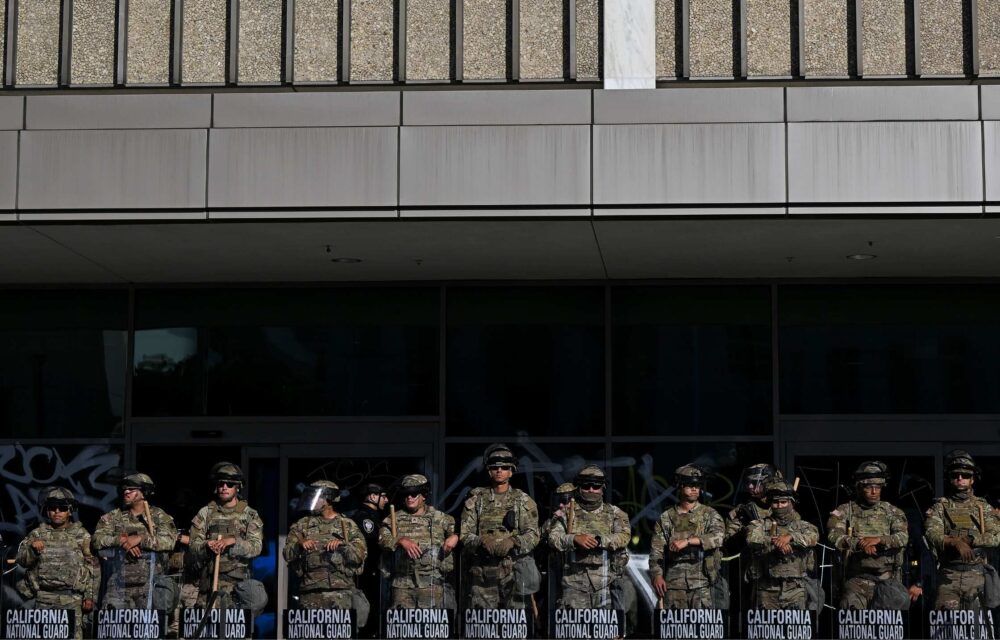
Since early June 2025, the Trump administration has deployed National Guard and military units to several American cities, purportedly in response to protests or crime. Federal courts have stopped some of these deployments and have questioned the administration’s depictions of local events and its rationale for deploying additional forces, but questions remain regarding the President’s authority to deploy American troops into communities.
This explainer addresses common questions about how the President has used the military in cities across the United States, provides an overview of the Posse Comitatus Act and the Insurrection Act, and analyzes the legal issues that come up when troops are sent into American communities.
If you see federal troops or National Guard units being used like police—such as making arrests, detaining people, or using force—that could be a violation of the law. If that happens, you should contact NILC, your local or state immigrant and civil rights organizations, or trusted local and state officials. You can report potential violations of the law by the military to NILC at [email protected].
-
Is it legal for the President to send the U.S. military into American cities to control protests, fight crime, or arrest and deport immigrants?
No, it’s not legal outside of specific and rare circumstances. One of the most important rules in American democracy is that the President can’t use the military like a police force inside the country. This separates the United States from countries where leaders use soldiers to control their own people. The Supreme Court has said that Americans have a long tradition of resisting “any military intrusion into civilian affairs.” This idea goes back to before the United States was founded and is written into a law called the Posse Comitatus Act, passed in 1878. That law says the military—like the Army and Air Force—can’t be used to enforce laws inside the United States unless Congress or the Constitution specifically allows it. In part because of this prohibition against domestic law enforcement, members of the military are often not trained to deal with scenarios that frequently arise during law enforcement in American cities, including during protests.
-
Under the Posse Comitatus Act, what can and can’t the military do if it’s sent into U.S. cities?
The Posse Comitatus Act says that the regular U.S. military (and the National Guard when under federal control) can’t act like police inside the country. That means they’re not allowed to:
- Arrest or detain people
- Search or question people
- Take property
- Patrol protests or block off public areas
- Help with immigration enforcement, like arresting or detaining migrants
There are a few exceptions to the general prohibition against domestic law enforcement by the military—for example, if a crime happens on a military base, the military has its own justice system to handle it.
However, the military can help in other ways that don’t involve direct law enforcement. For example, they might:
- Build border walls
- Let immigration agencies use space on military bases to hold or process migrants
-
What is the Insurrection Act?
The Insurrection Act includes a number of provisions of federal law that date as far back as 1792, and allows the President to use the military inside the United States in certain emergencies—like stopping a rebellion or helping when local police can’t handle a situation. The Insurrection Act is also the main exception to the Posse Comitatus Act.
But the President can’t just use the Insurrection Act whenever he wants. He has to officially announce that he’s using the Insurrection Act, and he can only do so during a real emergency, as defined by the law. Largely peaceful protests against unjust immigration enforcement policies are not an emergency under the Insurrection Act.
Over the past 50 years, the Insurrection Act has only been used three times, and not since the 1992 Los Angeles riots, a crisis during which the governor of California requested invocation of the law by the president. And the last time the Insurrection Act was invoked over the objection of a state’s governor was in 1965, when President Lyndon B. Johnson sent the U.S. armed forces to Alabama to protect protestors who had been attacked by Alabama state troopers at the Edmund Pettus Bridge.
-
Are there other laws that govern domestic use of the National Guard when the Posse Comitatus Act doesn’t apply, including the invocation of the Insurrection Act??
Yes. Even when the Posse Comitatus Act doesn’t apply, there are still laws that limit how the National Guard can be used, and military deployments are always bound by constitutional protections such as the First, Fourth, and Fifth amendments. This means deployed military units can’t unconstitutionally restrict movement or speech, engage in unreasonable searches, or detain people without due process.
When the National Guard is under State Active Duty, it must follow the laws and rules of its own state, and its funding comes from its state’s budget. Also, if one state wants to send its Guard troops to another state, it must get permission from that state first.
Title 32 status was originally meant to help train National Guard units using federal money. In 2006, Congress expanded this status to allow Guard troops to do other jobs that support federal missions, if the President or Secretary of Defense asks for it.
However, this part of the law is still unclear, and courts haven’t ruled much on it. In our view, the law shouldn’t be interpreted in a way that allows the President to bypass longstanding restrictions on domestic use of the military contained in the Posse Comitatus Act.
-
Does the Posse Comitatus Act apply to National Guard deployments?
It depends. The National Guard is a sort of part-time, military reserve that can be used in different ways depending on who’s in charge. Most of the time, members of the National Guard aren’tperforming a military function at all. Instead, they are working civilian jobs and living out their private lives with their families. When they are called into service, they may bein one of three statuses:
- State Active Duty – The Governor is in charge. The Guard helps with things like natural disasters or local emergencies.
- Federal Duty (called Title 10) – The President is in charge. The Guard becomes part of the regular U.S. military.
- Title 32 – A mix of state control and federal funding intended to facilitate training to help prepare members of the Guard to fight America’s wars. The Guard stays under the Governor’s command but gets federal funding and can help with federal missions.
The Posse Comitatus Act, which limits the use of the military for law enforcement inside the United States, only applies when the National Guard is under federal control (Title 10). If the Guard is under state control, the law doesn’t apply.
However, when the National Guard is under State Active Duty, it must follow the laws and rules of its own state, and its funding comes from its state’s budget. Also, if one state wants to send its Guard troops to another state, it must get permission from that state first.
Title 32 status was originally meant to help train National Guard units using federal money. In 2006, Congress expanded this status to allow Guard troops to do other jobs that support federal missions, if the President or Secretary of Defense asks for it.
However, this part of the law is still unclear, and courts haven’t ruled much on it. In our view, the law shouldn’t be interpreted in a way that allows the President to bypass longstanding restrictions on domestic use of the military contained in the Posse Comitatus Act.
-
This all seems really complicated. How can I tell if a military deployment to my state or city is legal?
You’re right—it is complicated. Most of the President’s recent use of the military inside the United States is legally questionable, because it involves using troops in ways that Congress has (or the states themselves have) tried to limit, especially when it comes to policing. But because these situations are new and unusual, they raise new legal questions, and it’s up to the courts to decide whether a specific deployment is legal or not. Litigation brought by state or local governments will likely provide some answers in the coming months. The Supreme Court has already rejected the administration’s legal justification for sending troops to Chicago.
It’s important to remember that even in scenarios in which military deployments may be allowed, they are bound by constitutional protections such as the First, Fourth, and Fifth Amendments, meaning deployed military units can’t unconstitutionally restrict movement or speech, engage in unreasonable searches, or detain people without due process.
Again, if you see federal troops or National Guard units being used like police—such as making arrests, detaining people, or using force—that could be a violation of the law. If that happens, you should contact NILC, your local or state immigrant and civil rights organizations, or trusted local and state officials. You can report potential violations of the law by the military to NILC at [email protected].
-
Why is it harmful for the President to use the military for police work inside the United States?
The military is trained to fight wars, not to do police work in American cities. Soldiers follow rules meant for combat, not for dealing with civilians. Using troops like police can lead to dangerous situations, including violence or even people getting killed.
Using the military this way can also:
- Damage trust between the public and the military
- Put service members in difficult situations that they are not trained to handle
- Take away resources from important missions, like defending the country or helping in emergencies
That doesn’t mean the military can’t help during real crises. For example, troops often help after natural disasters like hurricanes or floods. They’ve also helped during public health emergencies, like helping support testing and vaccination efforts during the COVID-19 pandemic when hospitals and clinics were overwhelmed. But using the military to push political goals or control protests will only make it harder for troops to do the critical jobs they were trained for.
Cómo ejercer su voto de manera segura: guía para ciudadanos naturalizados y todo tipo de votantes habilitados
Published Oct 8, 2026 Esta guía está diseñada para ayudar a los votantes habilitados, incluyendo a los ciudadanos...
U.S. Military Likely Violated Posse Comitatus Act During 2025 Immigration Raids in California, New Document Shows
Published Oct 7, 2026 WASHINGTON — A U.S. military document newly obtained by the National Immigration Law Center seems to reveal a previously unknown Trump administration violation of the Posse Comitatus Act during its deployment of federalized National Guard...
Benefits for Immigrant Survivors of Trafficking, Domestic Violence, and Other Serious Crimes in California
Updated Oct 6, 2026 This resource reviews the two categories of immigrants covered by California's SB 1569 (trafficking survivors and U visa applicants/holders), the benefits they may receive, and what they need to show in order to get these benefits. Originally...