My name is Daniel Banda. I am a recipient of Deferred Action for Childhood Arrivals (DACA), a policy that allows undocumented immigrants who were brought to the U.S. as children to live and work here without fear of deportation. We have to reapply for these protections every two years.
Growing up undocumented, I constantly worried about things most kids never have to think about—like what would happen if my parents didn’t come home from work one day, or if I’d ever be able to go to college. I learned early on to stay quiet and avoid drawing attention to our situation. Pursuing higher education or a career in my passions never felt within reach—not because I lacked ambition, but because the barriers in front of us were deliberately placed and left unmoved.
While being undocumented does not define who I am, I carry it proudly as part of my identity, because I hope that other immigrant youth might see my work and feel inspired to pursue their own dreams, just as I did.
DACA changed my life. It gave me the chance to pursue my dreams.
DACA allowed me to attend college and become an Archer Fellow, which brought me to Washington, D.C., where I interned at the Embassy of Mexico and at a law firm supporting unaccompanied migrant children. Earlier this spring I had the opportunity to testify before the Texas Senate in defense of in-state tuition for undocumented students.
This summer, I am serving as a FirstGen Advocacy Intern with the National Immigration Law Center, contributing to teams that fight to protect and expand immigrant rights. I am also working with United We Dream’s Texas Leadership Council to mobilize immigrant youth. These are the same organizations that helped me navigate life as a scared immigrant. Now, I have come full circle—pouring my energy into the work that once helped me feel seen and supported.
I chose to become an advocate for immigrants to ensure that others do not face the same uncertainty and obstacles I experienced growing up. I want them to attend college, chase their dreams, and support themselves and their families—without the fear that their futures might vanish overnight. Immigration is often viewed as a divisive issue, but I am proud to stand up for people like me because we deserve more than silence.
DACA helped open doors for me, but far too many never had that chance. From the start, the policy excluded millions based on arbitrary eligibility rules. According to the Presidents’ Alliance on Higher Education and Immigration, nearly 2 million immigrant youth are ineligible for DACA or Temporary Protected Status (TPS), forcing them to navigate life in the only country they have ever known as home without any guarantee of safety, legal status, or stability. The Migration Policy Institute also found in 2021 that approximately 3 million undocumented immigrants who arrived in the U.S. as children could benefit from legislation like the Dream Act. These figures underscore the urgency of moving beyond temporary protections toward permanent legislative solutions.
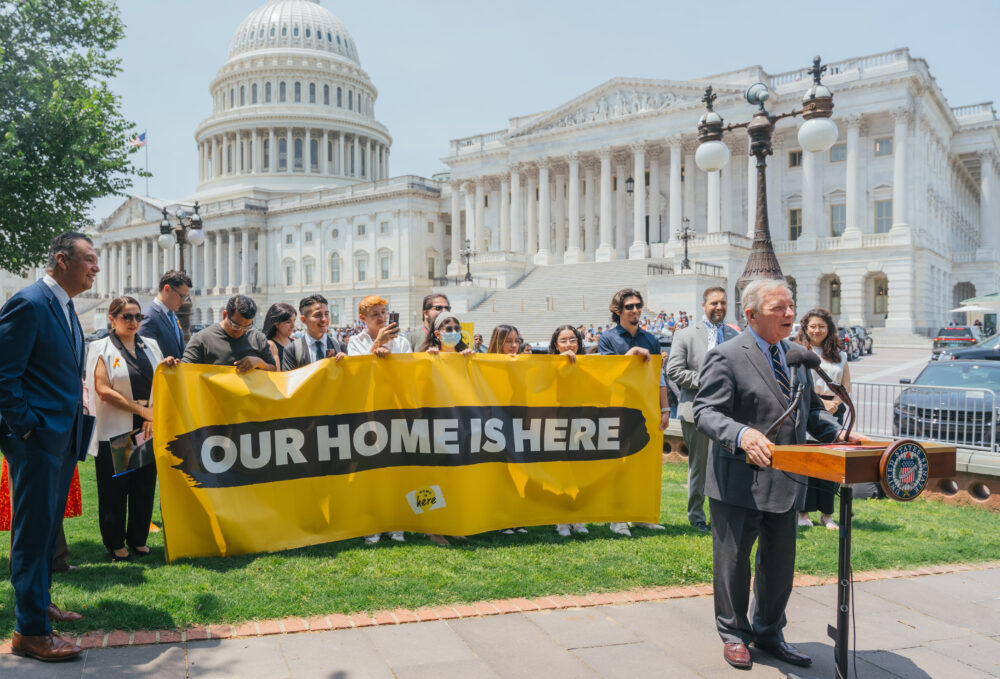
I received DACA just seven days before the Trump administration’s first attempt to rescind it in 2017. Seven years later, I stood on Capitol Hill to commemorate its 13th anniversary on June 11, 2025. On that day, I was advocating not just for my future, but for the millions of immigrant youth who were never eligible for protection. I was not there to spectate—I was there representing the National Immigration Law Center, joining advocates who have long uplifted immigrant voices. Part of my story was shared, as I stood proudly alongside other DACA recipients, immigrant youth, allies, and members of Congress.
As the future of DACA remains uncertain, people like me and countless others across the country are left with our lives on hold.
That is why we must call on Congress to act.
In February of this year, Reps. Sylvia Garcia (D-TX) and María Elvira Salazar (R-FL) reintroduced the bipartisan American Dream and Promise Act of 2025, a bill that could finally offer stability to DACA recipients and immigrant youth by giving us permanent protections and putting us on a pathway to citizenship.
Polls consistently show around 70% of Americans support a path to citizenship for DACA recipients and immigrant youth. Yet even with strong bipartisan backing, Congress continues to stall.
We cannot afford more delays. The stakes are too high. Across the country, immigrant communities are living in fear as this administration escalates its mass deportation efforts, targeting even immigrant youth. In Texas, public universities have been instructed to identify undocumented students just two weeks after the U.S. Department of Justice sued to block their access to in-state tuition. This raises serious concerns about how this data will be used in enforcement efforts nationwide.
We are asking for the opportunity to pursue a life with dignity, safety, and stability in the place we call home. DACA has proven that a work permit alone can provide a lifeline: the ability to attend school, help our families, and build a future. But that is not enough.
We need a pathway to citizenship. And we need it now—without conditions, without bargaining, and without delay.
Congress must establish a direct, permanent pathway to citizenship—immediately. Our futures are not negotiation chips. We have waited long enough.
I will keep fighting for immigration reform so that no one has to grow up feeling afraid of simply existing. If a kid like me could make it this far, imagine how much more we could all do, if only we were given the chance.
Tell Your Representatives in Congress to Support the Dream and Promise Act Discharge Petition
Published Jul 23, 2026 Across the country, immigrants with TPS and DACA are losing the ability to work, drive, and ultimately continue their lives in the United States. Join us in urging your House representative to sign the Dream and Promise Act discharge petition...
Steps to Take if Your DACA Renewal Is Delayed
Updated Jul 7, 2026 This resource provides guidance for DACA recipients on renewing their status and employment authorization documents, including steps to take if there are delays in processing their renewal applications. Originally published in July 2016. This...
What does the BIA Decision Mean for DACA recipients?
Published Apr 30, 2026 If someone with DACA gets arrested and detained by immigration or other law enforcement and ends up before an immigration judge, the judge may now look into their case more closely to comply with the BIA decision. However, the decision does not...
Speaking Up: My Story And Why Your Voice Matters
Jul 22, 2025